
Reduced heat transfer
Building performance systems
Thermal, Acoustic and Fire Insulation Solutions in Nepal
Select rockwool, glasswool, XPS, EPS, PUF, nitrile rubber and reflective insulation for roofs, walls, ceilings, ducts, pipes and industrial projects in Nepal.
Related searches:rockwool Nepalglasswool Nepalroof insulation Nepalthermal insulation Nepal
01Reduced heat transfer
02Improved indoor comfort
03Acoustic absorption options
04Fire-performance options
Plan before you purchase✓ ✓ ✓ ✓ ✓ ✓
A complete system, not an isolated product
Use this page as a planning guide, then confirm project-specific dimensions, performance requirements, drawings, site conditions and commercial scope before procurement.
Improved indoor comfort
Acoustic absorption options
Fire-performance options
Condensation-control coordination
Solutions for buildings and services
Technical planning
Important decisions before quotation
Each part of the system should be coordinated with the other parts, site conditions and the intended operating environment.
Select insulation by assembly
The same material performs differently in a metal roof, cavity wall, exposed duct or cold-room floor. Confirm the complete assembly, exposure, thickness, compression, vapour control, thermal bridges and fixing method.
Climate and condensation
Nepal projects can face strong solar gain, cold nights, monsoon humidity and large elevation-related temperature differences. Insulation should be coordinated with ventilation, vapour control and water management to reduce condensation risk.
Fire and acoustic requirements
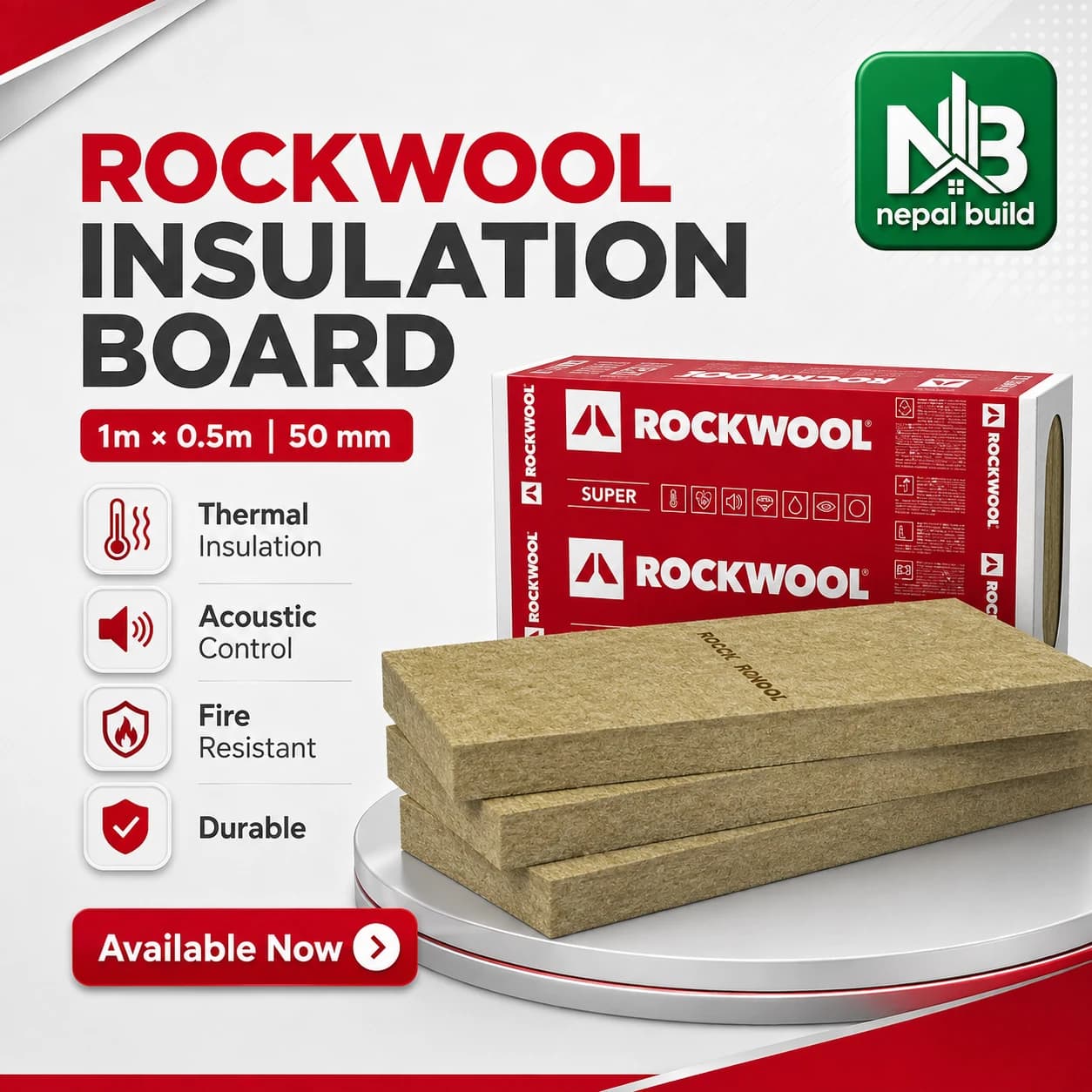
Rockwool and glasswool are often considered where non-combustibility and sound absorption matter. Fire performance should be verified for the complete tested system, including facings, joints, penetrations and supports.
Thermal calculations and approved data
Use declared thermal conductivity and actual installed thickness to estimate R-value and U-value. Final calculations should include surface resistances, thermal bridges, gaps, moisture and manufacturer-specific data.
Typical applications
Where the system is commonly used
•Metal roofs
•Prefab walls
•False ceilings
•HVAC ducts
•Pipes and tanks
•Industrial enclosures
Related products
Continue to the technical catalogue
From inquiry to handover
A clearer project process
- 01Identify roof, wall, ceiling, duct or pipe application
- 02Define temperature, fire, acoustic and moisture targets
- 03Review substrate and service conditions
- 04Compare material options and thickness
- 05Calculate thermal performance
- 06Prepare accessories and fixing schedule
- 07Approve product data and quotation
- 08Install and inspect continuity
Frequently asked questions
Answers before you proceed
Final design, quantities, performance and price require project-specific review.
Talk to the project deskWhich insulation is best for a metal roof in Nepal?
Selection depends on roof build-up, heat gain, condensation risk, fire requirement, acoustic need, available depth and budget. Glasswool, rockwool, PUF/PIR panels and reflective layers are common options.
Is thicker insulation always better?
Greater thickness usually increases thermal resistance, but installation quality, compression, gaps, thermal bridges, vapour control and the full assembly can be equally important.
Can insulation reduce noise?
Fibrous insulation can absorb sound within cavities, but reducing sound transfer also requires mass, sealing, decoupling and control of flanking paths.
Ready for a project-specific review?