
Reduced sound transfer
Noise control and room acoustics
Soundproofing and Acoustic Room Solutions in Nepal
Plan sound isolation and acoustic treatment for studios, home theatres, offices, classrooms, restaurants and industrial spaces in Nepal.
Related searches:acoustic room Nepalstudio soundproofing Nepalnoise control Nepalacoustic panels Nepal
01Reduced sound transfer
02Controlled echo and reverberation
03Improved speech clarity
04Room-specific material schedules
Plan before you purchase✓ ✓ ✓ ✓ ✓ ✓
A complete system, not an isolated product
Use this page as a planning guide, then confirm project-specific dimensions, performance requirements, drawings, site conditions and commercial scope before procurement.
Controlled echo and reverberation
Improved speech clarity
Room-specific material schedules
Door and service-penetration coordination
RT60 and BOQ tools
Technical planning
Important decisions before quotation
Each part of the system should be coordinated with the other parts, site conditions and the intended operating environment.
Soundproofing is different from acoustic treatment
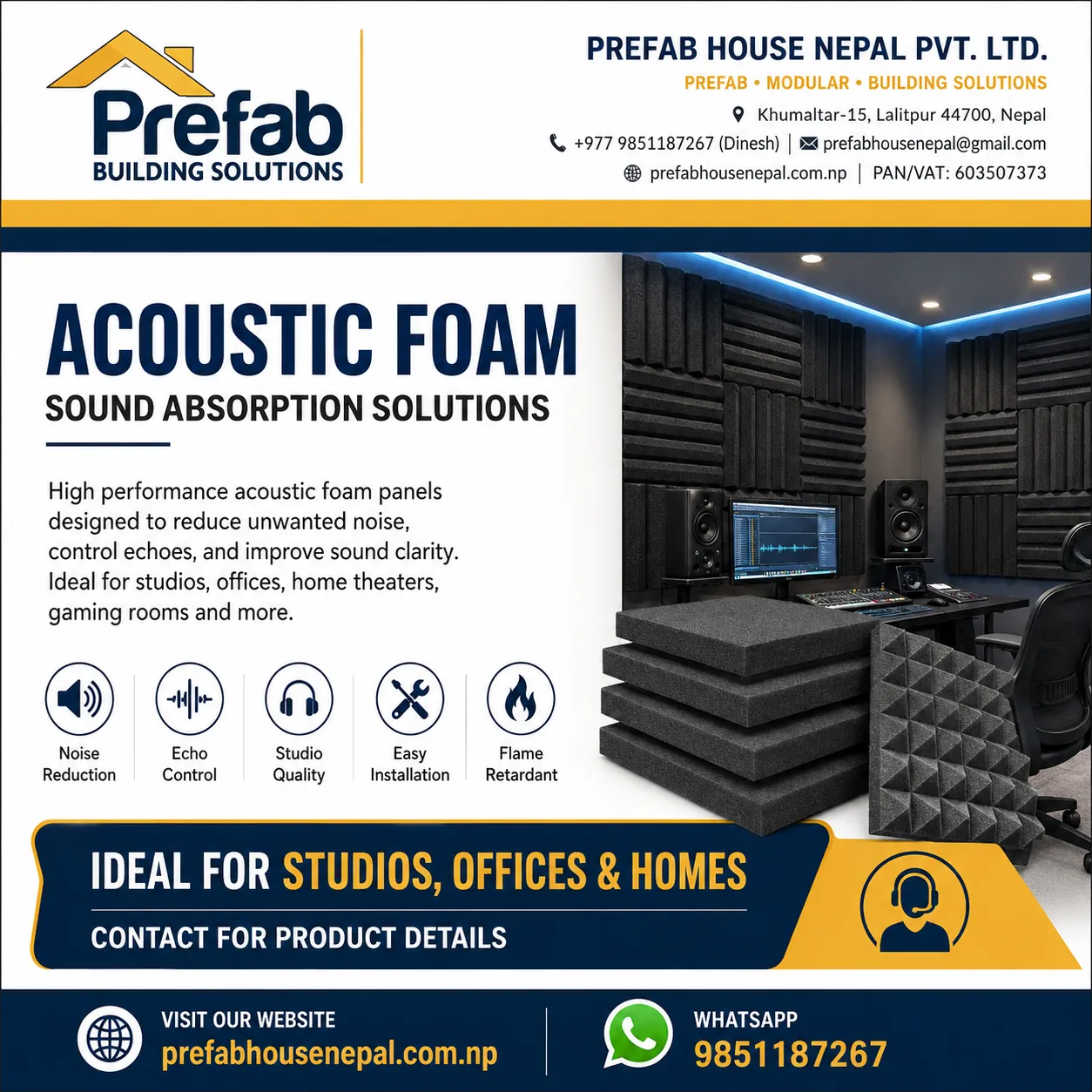
Soundproofing reduces sound transfer between spaces. Acoustic treatment controls reflections inside a room. Foam or decorative panels can improve echo but do not replace mass, airtightness, decoupling and flanking-path control.
The weakest path controls performance
A high-performance wall can be undermined by an untreated door, open ventilation path, ceiling void, floor junction, service penetration or rigid structural connection. The complete room boundary should be reviewed.
Room use and target reverberation
A podcast room, music studio, classroom and restaurant need different reverberation characteristics. Room volume, surface finishes, occupancy and frequency range influence treatment area and absorber selection.
Build a measurable BOQ
A soundproofing BOQ should separate isolation layers, framing, resilient channels, cavity insulation, boards, membranes, sealants, acoustic doors, ventilation silencers, absorbers, bass control, floor isolation and specialist labour.
Typical applications
Where the system is commonly used
•Recording studios
•Podcast rooms
•Home theatres
•Meeting rooms
•Classrooms
•Mechanical and industrial rooms
Related products
Continue to the technical catalogue
From inquiry to handover
A clearer project process
- 01Define noise source and room use
- 02Measure room dimensions and openings
- 03Identify walls, ceiling, floor and service paths
- 04Select isolation and treatment targets
- 05Estimate RT60 and treatment area
- 06Generate material BOQ
- 07Approve details and product data
- 08Install, seal, inspect and test
Frequently asked questions
Answers before you proceed
Final design, quantities, performance and price require project-specific review.
Talk to the project deskWill acoustic foam soundproof a room?
No. Acoustic foam mainly reduces reflections inside the room. Sound isolation normally requires airtightness, mass, decoupling, cavity absorption and control of doors, ventilation and flanking paths.
How much wall area should receive acoustic panels?
Coverage depends on room volume, current reverberation, target RT60, absorber coefficient, furnishings and room use. Use the RT60 calculator for a preliminary estimate.
Do acoustic doors matter?
Yes. Doors are often a weak point because of lower mass and perimeter gaps. Door construction, frame sealing, drop seals and hardware should match the isolation target.
Ready for a project-specific review?